RCT: AI-Assitance Effect on Reading X-Ray Accuracy
Explore the randomized controlled design, assistance mechanism, and causal plan. Switch arms to see intended behavior channels and the KPIs you’ll analyze in ITT models.
Arm 1 — Control (No AI)
Intent: Establish baseline reader performance without assistance.
Mechanism: Radiologist reads the CXR unaided; no suggestion/uncertainty framing is shown.
Diagnostic Accuracy (AUC)
—
Fill from ITT
Escalation Rate
—
CT / specialist referral
Reading Time (sec)
—
Calibration / Overconfidence
—
Experiment Proposal
- Protocol: reader-level RCT (3 arms)
- Post-decision reveal (control extension)
- Adaptive uncertainty framing (Arms 2/3)
Agent Design
- Explainer prompt + verifier guardrails
- Latency SLOs + privacy
- UI payload schema
Causal Analysis
- ITT models + robustness
- Endogeneity mitigation plan
- Design spec (estimands, masking)
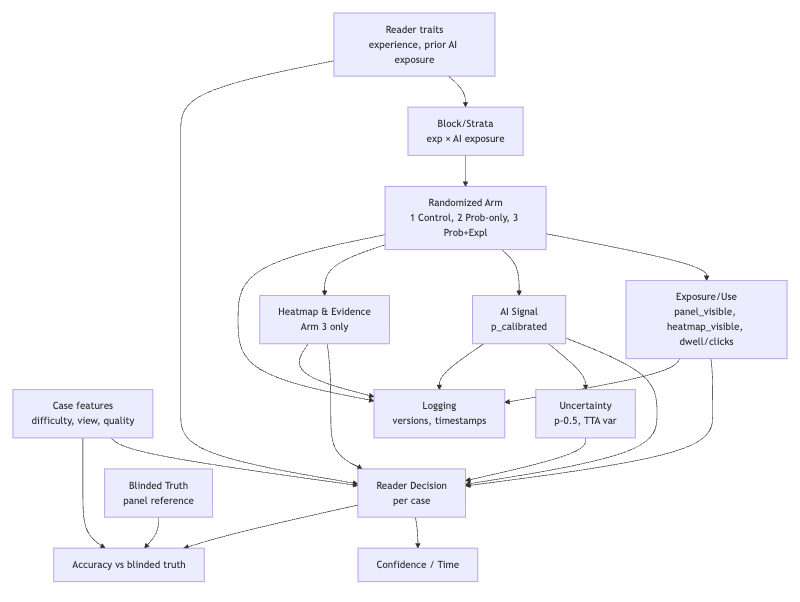
Click to view full size
Why this matters
The experiment measures not just model accuracy, but how human+AI decision loops change: escalation choices, time to decision, and responsibility. Arm 3 tests whether calibrated uncertainty framing improves safety and reduces over-trust.